Monday, June 5, 2017

Comedy In Tulsa

A show with professionals, not amateurs trying it out, so I was expecting more from the comedy side but not as much on the "telling of local values" side.

There was an opener, who was local, that talked mostly about this life and at one point mentioned that though he was half Mexican he was "the good kind," a joke similar to something I had heard in heavily immigration oriented Arizona. I was not amused by the rest of his set, but that was just coincidental.

Though it was a full sized comedy club, only 10 to 15 people were actually at this event, allowing for the comedians to get really comfortable with and talk to their audience.

And the next comedian did just that.

He was a Black guy from Cleveland, talking about his experiences and life. I did not think much of his act, I chuckled here and there, until he turned right to me and asked me how old I was. I said 18.
Then he asked if the man next to me was my father, I said yes, and he asked us where we were from. My father replied, the comedian detected the accent, and asked him where he was really from.

That's when the fun started.

No, really, it was fun.

He was doing his usual set, but with the occasional nod to my father and I, especially since we were the only other Black people in the audience and we could relate to his jokes more. He even imitated my father's interactions with me, as in how we would respond to his jokes, and we laughed even harder.

And I don't know how he did it, but it was not disrespectful. I even asked my father, whom the comedian imitated, and he did not feel disrespected. But there are a number of factors at play here:
-we were sitting in the front row and there weren't many people there, he was bound to pick on us
-it was comedy, he was not trying to be malicious or hurt us, just make people laugh, including us
-he never crossed the line or made any personal attacks
-most importantly, he was Black

That last point may come across as controversial, but that is good. We knew that, if anything, this guy respected us like any other decent audience member, but we had a connection because of the amount of melanin in our skin. Not because our lives are similar, but because of how we are treated by society.

This was why I laughed even harder at his jokes, because I knew he understood. Even if it wasn't necessarily the part of my father not being from America, I knew that he knew that Black people do not need to be brought down more, especially not by a member of the community.

In Arizona I saw a white-passing guy make some jokes about people of Latinos and Japanese people, and I just felt annoyed while other white people (and people of some other races) laughed. Because he was poking fun and making a mockery of these people from a position of privilege in this country, making surface level judgments and not caring whatsoever about what the rest of their lives must be like. This is inconsiderate and rude, especially when the actions of these people, which he characterizes to make it seem like they inconvenienced him, are later turned around into a stand up routine in a competition for money.

But this Black comedian in Tulsa got it. His jokes about being Black were funny because they were true, and I know they were true because I am Black myself. Forgive me if I am speaking in circles but this is about community, and there are some things that can only be fully comprehended when you're a member.

The last comic was an older gentleman that had seemed like he had been at this for a while, so I was expecting much of him. Speaking honestly, he made a lot of crude jokes about sex and women and I was taken out of it because that isn't really what I find funny, but it made me think about my own preferences and how comedians need to find a niche.

I appreciate comedy that makes you think about yourself and your world, so much so that you are pondering the joke days later, not because you are still laughing but because it made you think.

And successful comedians have a niche. Something that they are known for that they can build a fan base, tailor made for them, around. They can branch out and go in new directions, but as long they stay true to their style, what made them well-known and well-liked in the first place, they are fine.

The Amon Carter Museum in Fort Worth

I forgot.

During the morning of day 10, before driving out to Tulsa, my father and I decided to catch some culture in Fort Worth and went to the Amon Carter Museum of American Art in Fort Worth.

The were many works about "Cowboys and Indians" that I, at one point, got fed up with the narrative, but after those exhibits were passe it explored more of the works of art done by Americans and those living in America.

(Left to right then down)
Plexus no. 34 (2016) by Gabriel Dawes
Swing Landscape (1938) by Stuart Davis
Amon G. Carter (2008) by Scott Gentling

Admission to the museum is free.

At the end of our time there, I decided to interview a woman that works there that said she was not particularly busy. She was welcoming and willing to answer questions, but I felt that, given her position, she had to give very diplomatic answers, careful not to say anything controversial that could be misconstrued as being the formal position of the museum on the topic, and possibly cost her her job. And I respected that.

There was not much aside from her contentment with the community of Fort Worth that I was able to get, but she did offer up an interesting response to my question about issues with the community.

She noted that the community she knows the best is the art community there, and it is difficult for newcomers to break into circles and get to know the right people so that they may be able to sponsor them or just help them get their name out there. This conversation about how exclusive and elitist these circles can be was not new to me, but it made me think about how people can self-define what community they belong to.

Sure, there are certain communities that people are going to immediately associate with you based upon solely physical criteria (race, residential area, etc.), but the rest is totally up to you. You can identify with those that share a profession as you, which is part of the driving force behind unions (there would be no unifying force to support collective bargaining if there was an identification of a community to begin with), hobbies, interests, and the list goes on and on.

Then we get into other conversations of prioritizing your communities and how you contribute to them, but it all starts with the social idea of people that share a similar something, really anything, and coming together on it.

I figured this may affect how people view and interpret the news. An ecologist community is outraged over climate change, but those working in manufacturing and shipping may view it as an incidental byproduct of their job, something to support them and theirs.

Communities can be beneficial, toxic, involved, destructive, etc. but we have to know what we want to belong to before we can make any substantial comment on how it works, because observing and experiencing are two different things.

Days 10 and 11: En Route to Tulsa and Tulsa, Respectively

This was a pretty short, straight to the point day.

We left in the hotel in the morning-- which I was thankful for because I had overlooked the fact that I had booked a room that allowed smoking, therefore the room smelled like smoke and was not a fun environment for my lungs, my fault though--, got some breakfast at Waffle House, then we were on our merry way up north to Oklahoma, Tulsa to be specific.

Speaking candidly, it was a long drive, four and a half hours or so, but it was one of our shorter drives so I was glad. We reached our hotel and just chillaxed for a bit.
I, being the homebody, actually antisocial, rooted-in-ideas-not-places, out of the moment person I am, just wanted to stay in the room and order a pizza or something.

My father, on the other hand, wanted to explore the city.

So we went out, navigating to Downtown Tulsa. The buildings were cool and whatnot but there were not many people out-- granted, it was a Tuesday night-- so I just decided to drive around and literally see where the roads took us. I even drove through a little residential area, which, for once (you know what I'm talking about if you've seen the first minute of Jordan Peele's movie "Get Out"), was a good idea.
Because I came across this.


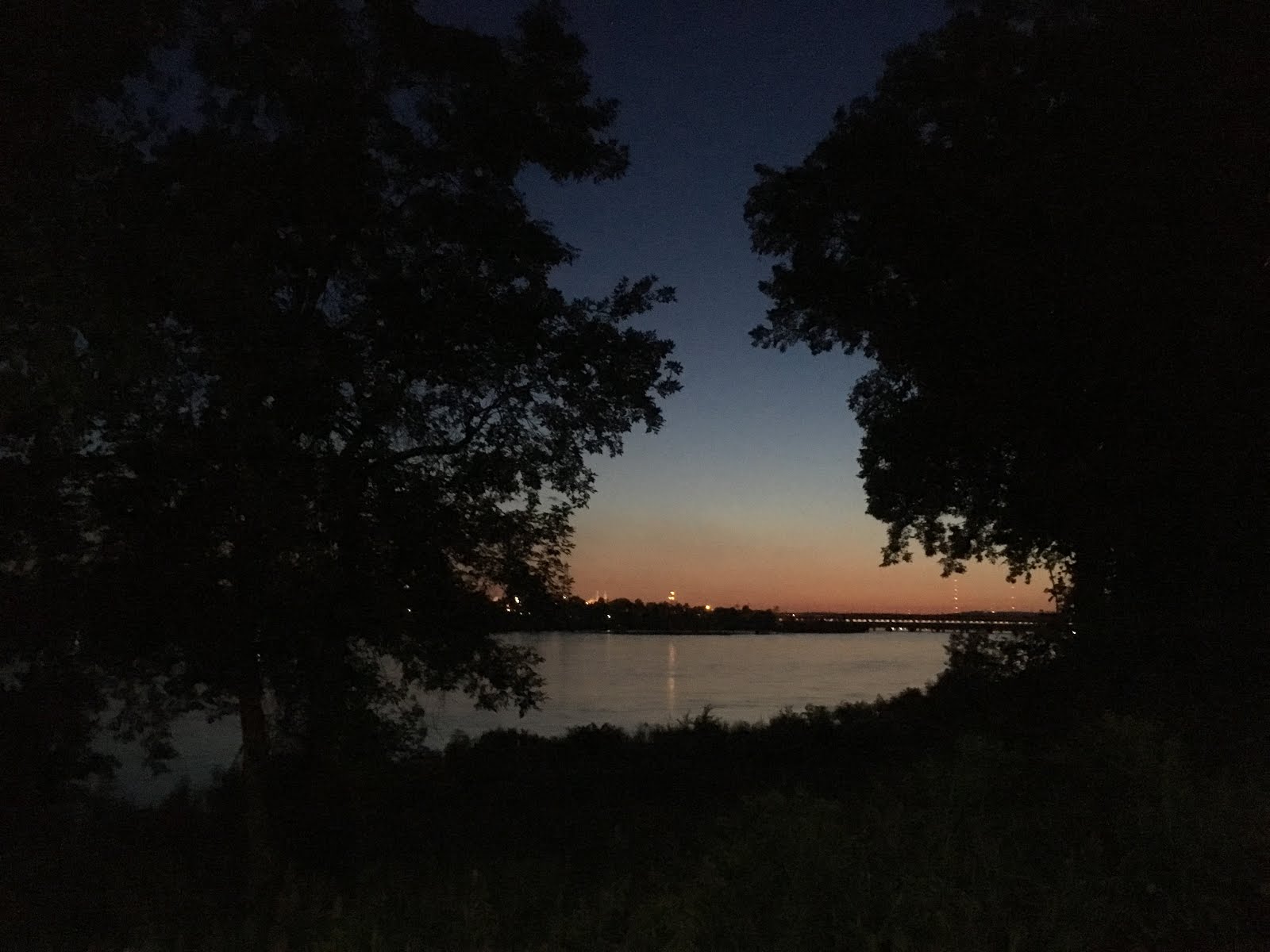
These are photos from the walkway that parallels the Arkansas River, which separates West Tulsa from the rest of the city. Pictured here just after sunset, it was a calming, reassuring, and enjoyable end to a long day.

Afterwards we did some more driving, explored West Tulsa, and then tried to find a food place open past 10pm (spoiler alert: there weren't many). We finally ended up at IHOP.


Pictured are my beloved father and the full on meal (I was already halfway through the red velvet pancakes when I remember I am trying to track my meals) that the waitress doubted I could finish.

I could have proved her wrong but I wanted to save the pancakes for the following morning.

THE NEXT DAY

Was super lowkey, and that was on me. I got off to a late start, and really only had time to eat dinner at a Vietnamese restaurant before going to the comedy show of the night.

(More on the comedy show in the next post)

Afterwards we headed back to the hotel room, but not before I made a u-turn to stop at a parking lot and take a few photos of aspects of the city that looked cool to me.

Can you tell that I am a night person?

And the night was ended with some delivery pizza, comfort food for a day marked by being comfortable.

I've Been Slacking...

But I'm back and better than ever!

Okay maybe not all that but I am here. Things have been getting hectic so I have not been keeping up here but excuses aside, I am glad to be back, laptop in hand, typing to my heart's desires. And thus, without further ado, the blog continues!

Wednesday, May 31, 2017

Day 9: Memorial Day in Fort Worth

A day for remembrance for those that fought and died for us. A day to be grateful and appreciative for those that made the ultimate sacrifice for this country, but more importantly those that inhabit it.

Noting the occasion and how many businesses were going to be closed for the day, I decided to look up what would be going on in the Dallas/Fort Worth Area to commemorate.

After more lounging around (told you I was addicted sleeping in and the lifestyle that comes with it), we hit the road for Dallas, about a half hour from our hotel in Fort Worth. We went to a local restaurant, Rodeo Goat, and decided to go to a nearby fireworks show.


But when I tell you the park hosting the show was crowded...


That is a far away shot but from a moving car it was decent enough. So there was hardly any parking and we decided to call it a day. We were both tired and I personally am not a big fan of fireworks.

This was a short post so here are some more photos of Downtown Dallas:


(yes there are still dead bugs on the windshield I'M SORRY)

Day 8: Fort Worth

This day got off to a slow start. It was gloomy outside and life on the road was starting to catch up to me. I slept in for the first time since the trip began, and it has been an addiction since. 

After a late start to our day, my father and I decided to get lunch at a local Applebee's in Burleson, Texas. Realizing that I had yet to interview anyone yet, I took this as an opportunity to look for potential additions to this project.
I saw a table of four elderly African-American women enjoying their meal and thought that they could offer some meaningful insights into the community and they would also be a new cultural perspective added to my greater analysis.
I was really careful with my approach, noticing that this was likely a gathering of friends and they might not want to spend their time chatting with some random kid. I asked if they would be willing to be interviewed once they were done eating, and they say it was okay with them, so I returned about 20 minutes later after I had finished my meal as well.
I did not ask to record them because I was already asking much of them by disrupting their get together. Only one of the four women was really willing to speak to me, which is fine, but I fear that the others may have harbored slight disdain for my bold approach.
Anyways, she offered up very thoughtful comparisons to trends she notices today and what she lived through, having resided in Southern California but also Alabama during the time of the Civil Rights Movement. She spoke of how she and those she knew were "being hosed down, dogs sicked on [them], and [they] still have some burn marks." This paints the world she comes from and with how readily she brought this up I got the impression that these are events fresh in her memory that heavily influence how she views today's world.

She also spoke about her childhood in Loma Linda, California, admiring the work done by activists like Malcolm X and Dr. Martin Luther King, Jr., but how it was a major culture shock when she first moved to Fort Worth, which was less diverse than what she was used to, and noted that a lot of what she viewed about the place was "rigid", from their church and style of worship to their general lifestyles. She lives in a more diverse area now, though, but does emphasize how there are many opinions and types of people that one may encounter in Fort Worth, which she still considers a "nice place."

She had an interesting take on terrorism. She mentioned that, as a Christian, it was a sin to commit suicide for whatever reason, but she also stressed that terrorist attacks like that are not what Islam is about, and how these people are of far more use alive than dead.

"People need to be alive to tell their story. People like Blacks and Jews did not have much of an option but they still fought for their lives sand now serve as triumphs of the human spirit. That is what makes them memorable. Those that kill themselves in this fashion are more likely to be forgotten as an individual. I feel bad for their mothers, having these beautiful babies that go and throw their life away." She cited that a major issue for this may be a lack of education, not in a formal sense but more along the lines of teaching people to know their worth and value as human beings with something to offer the world.

I also interviewed my server at this Applebee's, a young white guy who considered himself a nerd while growing up. He was a military kid that moved a lot growing up, but had spent some time in Fort Worth before and had now been back for about a year. He also said the community was friendly, with familiar faces willing to say hi outside of their usual places of interaction. He said that there is a generational divide in the community about how people feel towards Trump in the White House, with older residents being more encouraging while younger ones not really willing to give anyone a chance. He considers this to be due to technology. We can now access information faster and in this new age that is constantly advancing, Trump offers a return to a time that was simpler for these older folks.
He also noted that young people are more inspired nowadays. Not just in Fort Worth, but also back at his high school in Wisconsin, where 12 of the 97 students in his graduating class joined the armed forces. Young people are tired of hearing a lot of what is going on to the United States are because of the United States and they want to do something about it. This is something I am beginning to notice as well. These methods include:
-joining the armed forces
-contacting local representatives
-organizing and participating in protests
-starting petitions
-rallying
-working on campaigns for their favored candidates
And a number of other ways to get involved and hopefully influence our political system. A lot are productive and better the person while also benefiting the country, others not so much. And education is the major difference between a major political action being inspirational or deplorable.

Uhh Day 7 (?): Texas, the drive and the show

I left New Mexico with high spirits. Things were going well and I was getting a nice little streak going with interviews. Next stop: Fort Worth, Texas.

Though I know it is necessary to keep an open mind throughout this experience, I was wary about this next stint of my trip, especially Texas. Though I've never spent much time in the South, I knew that caution was of high concern, and my fears were not alleviated whatsoever when a friend of mine, who is born and raised in Texas, warned me of staying out late due to a recent spike in hate crimes.

Regardless, I pushed these thoughts aside and embarked on this next leg. We made our first stop in Claude, Texas, near the border with New Mexico and a pretty rural place. We got gas and stopped for food but it felt like a very uninviting place. We did not see a single person of color, and even my father detected slight hostility from one of the workers there (there could have been a number of reasons for this behavior, but that does not make it any better). I do not want to give the sense that we were in imminent danger, but my intuition was telling me that the sooner we got out of there, the better.

(Horses!)
After that minor tense moment we were back on the road. We made one more stop for gas before arriving at our hotel at around 7:56pm.

But we had to go to a comedy show at 8pm.

So we just pulled out of the parking spot we had just pulled in to. After a confused search for parking in Downtown Fort Worth, we saw a show by a comedian named Sledge (sadly could not find his name) at Hyena's Comedy Nightclub.

               This is when I learned another something about comedy. People like hearing jokes about themselves, but mostly if it is from someone that identifies with them. The comedian was a native of Texas, so he made a number of jokes about "rednecks" and "being from the country", at one point he even said "we all know a guy like that." And I think a part of this is a sense of pride that only allows itself to be taken in jest by one that belongs to the same group as them, because then it is more like to just be a humorous, astute observation instead of an baseless attack with malicious intent.

It seems like there may also be a sense of elitism within this style of comedy. There was not a single political joke made, which was a good move on behalf of the comedian, knowing that he is in a Trump voting state. But on the point of elitism, people are going to be up in arms if someone that they view to be socially inferior or below them detracts from their status through comedy. It disrupts the social order, which explains a likelihood to only be willing to accept  jokes about a community from one who actually belongs to it.
I am just postulating, but these trends do not just belong to this community of people in the country. As a Black person, I am exponentially more likely to find a joke about Black people funny if it is told by a Black person, and especially if it is a joke derived from a true story of theirs. Because then it is relatable. There is not the same idea of elitism as I had mentioned before, but rather protectionism against outsiders to the community that poke fun at it without having to live through the struggles of being a member. Almost as though being a member of these particular communities is a prerequisite or right of passage to have a substantial joke about the community that, once again, might really say something worthwhile.